Yoga classes in Baramati, Pune, Maharashtra, India 

Yoga Pranayam classes 
in Baramati. Dist- Pune, Maharashtra, India 

Yogacharya Dr .Nilesh Mahajan is a Ministry Of Ayush & Quality council of india certified Yoga teacher conducting Yoga classes in Baramati.


 Jeevanvidya Yog Ayurved foundation well known institute in Baramati ,Pune, recently started 1st Yoga Studio in Baramati. 

various courses are conducted by institute like

1) Certificate course  in Yoga Foundation (Basic)
2) Certificate course  in Naturopathy & Yogic science
3) Diploma  course  in Naturopathy & Yogic science
4)Diploma inYogic science


regular Yoga , Yogasan, Pranyam classes are taken on monthly basis

Timing of Regular Yoga classes 

Batch 1) 
Morning 6.30 am to 7.30 am

Batch 2)

for Ladies special Batch
evening 6 p, to 7 pm

Batch 3)

for Gents & Ladies

evening 7pm to 8 pm

Batch 4 )

for different types of Patient like 

Backache, Spondilosis, Sciatica, Knee joint pain, arthritis. frozon shoulder, Neckpain, Ankolosing spondilosis, Dibetes. Heart diseases are to be taken 


Contact Us

Yogacharya Dr.Nilesh Mahajan
JeevanVidya Yog Ayurved Foundation
Samruddhi complex, Opp. Motanagar, Suryanagari, MIDC, 
Baramati, Dist- Pune, Maharashtra, India
413102

Mobile - 9665823103 / 9420608637
Email- drmahajannilesh@gmail.com
blog- www.yogaayurved.blogspot.in


Specifications for Yoga classes in Jeevanvidya Yoga Ayurved Foundation

1) Quality council of india certified Yoga teacher
2) Special Attention
3) Scientific Yoga Teaching
4) Hath Yoga , Astang Yoga Teaching
5) Carrier opportunities in Yoga filed


Yogacharya Dr.Nilesh Mahajan's Video of Jalneti.  Yogacharya Dr.Nilesh Mahajan is certified Yoga Teacher by Quality council of India behalf of Ministry of AYUSH ,Govt. of India. . He is president of Jeevanvidya Yog Ayurved foundation, Baramati, Dist. Pune, Maharashtra State. Jeevanvidya Yog Ayurved foundation spreading Yoga & Ayurved science across the world.


The process achieves cleaning of the nasal path with the help of the water called as Jalneti. it is one of cleansing process mention in Hathyoga text.
Helps to cure sinusitis , migrane, diseases of eyes.
Apart from the purification of the nasal path, the other attached sensory perceptive organs such as eyes, ears can also be affected in a good manner and their efficiency is increased.
cleans sinuses. 
useful for diseases like asthma, allergic rhinitis, bronchitis, 

Yoga For Backache, Slip disc, Spondylisis.

Yoga for Backache

1)Parwatasan :(pava-taasana )
                             
1)      Sit in Padmasana.
2)      Now come in Namsakar Mudra, i.e Join the palms, press on each other and both elbows should be in one line.
3)      Raise both the hands up over the head, upper arm should be touches to ear, hands should be straight.
4)      Neck, Spine should be straight.
5)      Breath slow and deep
Advantages:
 If we breath deep in this asan then lungs capacity is inceases, abdomen and spine become strong and healthy.


2)Vakrasan :
                            
1)      Sit with the legs stretched out
2)      Bend left leg & place near right knee, in a such way that ankle joint of  left leg is in the level of right knee.
3)      Raise both hand in the level of shoulder, then turn towards left side place left hand on the ground behind spine as possible or one can place it near left hip.
4)      Twist the spine, press the left knee with elbow of right hand and hold the left ankle.
5)      Turn neck back.
Advantages:
1)      Strengthens and increases flexibility of spine muscles specially loins 
      2)      Due to twisting abdominal organ gets massage and increases there function, especially pancreas, lever, and intestines. Useful for diabetes, indigestion, constipation.
      3)      Help to remove abdominal fat.
     

    3)   Ardh Pawanmuktasan:

              
1)      Lie on the back. Hands together heals of the legs together
2)      Bend the right knee towards stomach &hold knee with both the palms,
3)      Try to give pressure on the abdominal wall with thigh. Concentration is on hip joint feel the stretching of hip joint . opposite leg should be straight.
4)      While doing for backache don’t raise head above the ground.
5)      Remain in this asan for 30sec to 1 min with slow & rhythmic breathing .
    6)      Then slowly relax. & repeat it with other leg.
Advantages:
     1)      This asan gives movement to hip joint which is not so common in day to day activity, so increases flexibility to hip muscle and relives back pain.
     2)      This asana also cures gastric troubles ,constipation, indigestion,


    4)   Ardha Shalabhasana:

                              
1)      Shalabh means loctus. In this position only one les is to be raised
2)      Lie down on the stomach with face down, chin touches to the ground
3)      Stretch both arms beside the body and clench the fists, (the hand can also place under the the thighs in Purna Shalabhasan)
4)      Concentrate on left leg & its muscle , pull the body and raise left leg as high as possible with knee should be straight .
5)      Stretch the soles of the feet towards back. Hold this position as much as you can and slowly                                                                                bring down. Repeat this with right leg .
Advantages :
       1)      This asan gives backward bending to the spine , reduces lumbar pain ,back pain.
       2)      Remove excessive fat around knees ,thighs waist and abdomen


    5)   Sarpasan:


1)      Lie in the floor face downwards, keep both the hands on each other, forehead on the hand.
2)      Now place chin on hand. Press both hand on the floor & raise the trunk up, make both elbow straight.
3)      Stay in this position, for about 20 to 30 sec.
4)      While coming down bend the elbows and rest the trunk on floor forehead on the hand.
5)      Reapeat the same for 2 more times.
Advantages:
1)      This is excellent for backche, sciatica, slip disc patients & disease in lumbar region.
2)      Spinal muscles gets maximum benefits,
3)      Neck extended fully, so thyroid gland,                                                                                                      cervical spine gets benefited.
                                                                                                 4)      Abdominal fat reduces.


      6)   Bhujangasan:


          There is minimal different in Sarpasana and Bhujangasan. In sarpasan we uses support of our hand to raise the trunk but in bhujangasana we have to use our back muscles for lifting trunk. There are some variation for this Asana. Lets see.
1)      Lie on the stomach, feet together.
2)      Place the palm on the ground in level of shoulders, elbow touches to the chest.
3)      Press the palm on the floor , raise the head and trunk,
    4)      As soon as you raise your trunk lift both hands from ground, hold trunk up. Stretch feet backwards so that toes touch the ground. Stay in this asan about 5 to 10 sec.
    5)      Slowly bring head ,trunk down to initial position.
Advantages:
    1)      This asan gives strength to Spinal muscle, cures spinal pain (lumbar ,cervical, spondylosis) , &other spine disorders( sciatica, Slip disc)
    2)      Remove disorders related to menstruation, stimulates blood circulation in uterus,ovary.
    3)      This asana increases the efficiency of lungs. 


     7)   Niralambasan:and Variation


       1) Lie down on stomach,
       2) Stretch the hands up over head, with both upper arm touches to the ear. Forehead touches to ground.  Stretch   
           both hands up from shoulder as possible.
      3)Now bend the elbow, raise the head up & keep the chin on the both palm. At this time try to keep elbow in forward direction.
            4)      Stay in this position for about 2 to 3 min. as time increases traction will be applied to the cervical region. and this give excellent result. 
            5)      Bend both knee. stretch toes up. Slowly do this movement of knee up and down for about 5 times
            6)      Now slowly come in initial position.
Advantages
            1)      This asana give traction to cervical region ,useful in cervical spondilosis, neck pain.
            2)      Increases blood circulation around neck area, helpful in hypo or hyperthyroid patients.


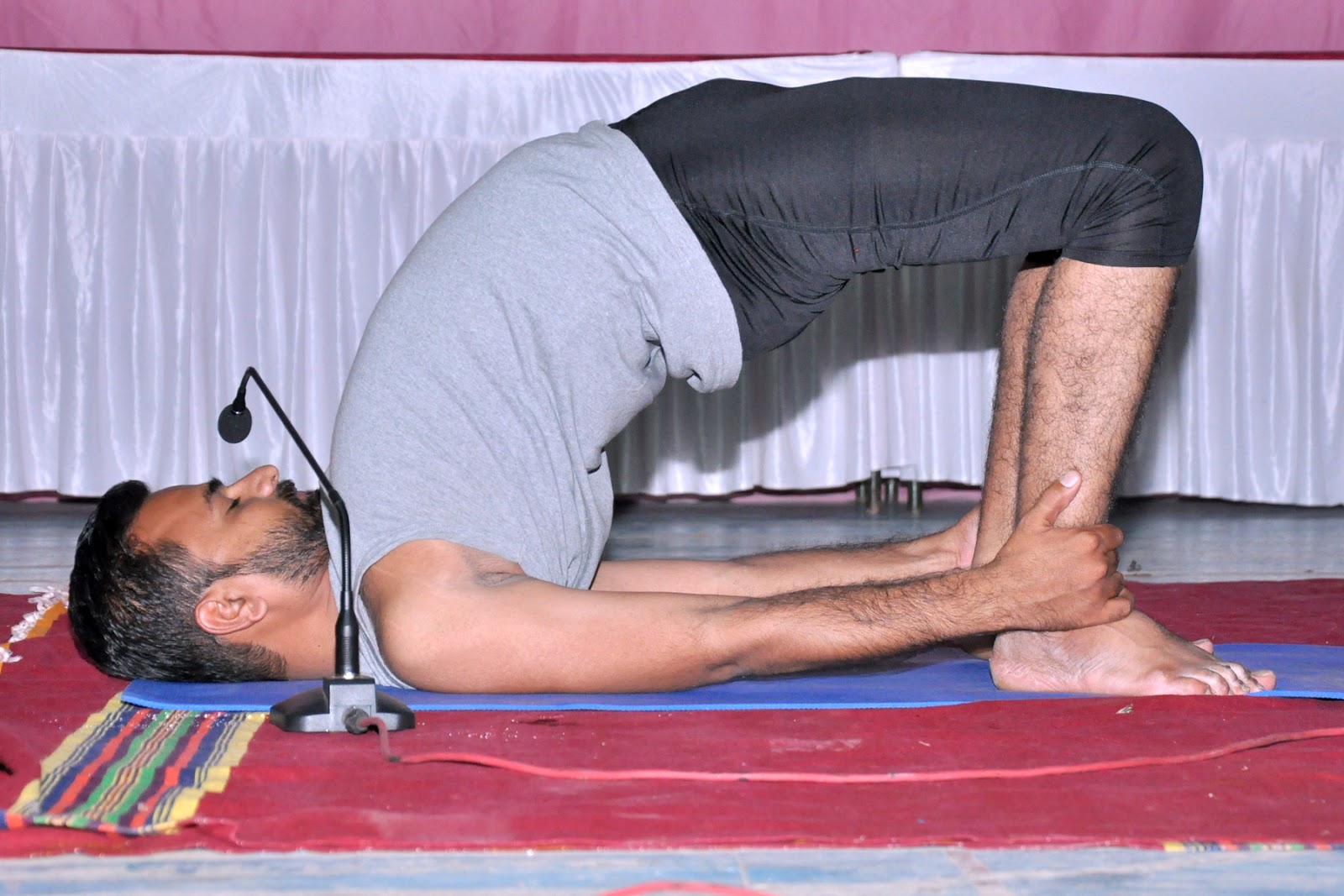
     8)   Setu bandhasana:
                            
1)      Lie on the back bend both the knees.
2)      Hold the both ankles with respective hands firmly if possible. Or you can place palm near hip.
3)      Raise hip ,thighs upward. Try to touch your chest to chin.
4)      Keep the back of the head ,neck & shoulder on the floor. Don’t raise heals, both feet should be touches to the ground.
5)      Hold this position fro 10 -30 sec as possible & the slowly relax
6)      Please note that patients suffering from cervical pain or disease do not try this asan.
Advantages:
1)      Exercise to back muscle, shoulder, neck. Makes spine flexible. And with practice this asan one can easily perform bhujangasan, sarpasan.
2)      Help to reduce abdominal fat ,
                                                                                    3)      Helpful in thyroid disease.


9)           9) Dhanurasan:


1)      Lie on stomach,face downward
2)      Bend the legs at knees, raise arms back & hold the ankle with hands. Maintaine this position for few sec, concentrate on back muscles.
3)      Slowly raise chest ,head up & try to lift the thighs from the ground, now body is like convex arch (bow) hence called as Dhanurarasan (Dhanura Means Bow), stay in this position for 5-10sec.
4)      Slowly come back.
Advantages
1)      Reduced fat over abdomen, cures constipation, dyspepsia & gastric troubles.
2)      Gives strength to back muscles, rejuvenates the whole spine. Correct minor deformities of spine.
3)      But it should be done under guidance atleast for first few days. 


10) Ushtrasan:

                             
1)      Initial asan for Ushtrasan is Vajrasan.
2)      Keep  both knees and heels in line with shoulder.
3)      Now slowly raise your hands from front in line with shoulder, inhale move right hand back and hold right ankle, then lt hand to hold left hand.
4)      Try to keep waist and knees are in one line, knees are in 90 degree.
5)      Extend your neck back.
6)      Stay in this position, this is Ushtrasan
Advantages:
1)      This asana help to develop elasticity of rib cage, beneficial for Asthama.
2)      Relives pain in neck, shoulder, Helpful for increase elasticity of shoulder joint and neck region.
3)      Maintain elasticity of spine, increases strength of paraspinal muscles.


 Some more advance Yogasanas , should be practiced after above Basic Yogasana


Yogacharya Dr.Nilesh Mahajan.
Ayurveda & Yoga Consultant
Baramati, Dist –Pune, Maharashtra, India
09665823103 / 09420608637
Email Id : drmahajannilesh@gmail.com


JeevanVidya Yog Ayurved foundation
Sharad Pride, 1st floor, Opp. Hotel Neelam Palace,
Lt.Gulabrao Dhawan Patil chowk, Phaltan Road, Kasaba
Baramati, Dist-Pune, Maharashtra, India.
9665823103 / 9420608637


Neti:

This is one of the important shuddikriya in yoga & It is very simple and easy to perform but it has tremendous results. The cleaning of the nasal path is known as neti. The aim of the process is to purify the breathing path right from the nostrils to the throat. Neti is again divided in two types

1)Jalneti:If the aim is achieved using water, the process is known as Jalneti.

2)Sutraneti: If the aim is achieved using thread (sutra) is known as sutra neti. Now a days we are using simple rubber catheter for this procedure.

         But vyutkram & Sitkram kapalbhati , (the process is performed by dipping nostrils in water which is in hollow of the hand , inhaling the water through the nostrils and letting it out through the mouth. The reverse process is sucking the water in by mouth and exhaling it through nostrils.) resembles with this procedure. Jalneti is easy to perform. infact prior to perform Vyutkram kapalbhati one has to learn Jalneti first. 

Jalneti:


How to do it?

For doing jalneti, a special kind of jug is used called as Netipot or Netilota.
1.     Take Luekwarm water in simple pot add half a spoon of salt to it. Water should be little salty in taste. Open the mouth and continue breathing through it.
2.     Now Put warm salty water into the Netipot. Tilt the neck and touch the tip of netipot (spout) to one of the nostrils. Open the mouth and continue breathing through it.
3.     Gradually pour water into the nostril. Further lower the head slightly & raise the netipot so that water which entered in to one nostril comes through another nostril.  During Jalneti, the position of the head and pot are adjusted to allow the water to flow out of the other nostril. When the pose is found, the rest of the process is easier. The water poured through one nostril can easily come out of the other.
4.     The breathing is naturally through the mouth at this time. Pour water into the left nostril and take it out of the right, then pour it by the right one and take it out of the left.
5.     The stream of water from both the nostrils will not be same depending on the blockade or nervous spasms. Do the whole exercise gently and in relaxed posture. One can wipe the nostrils with clean linen/towel in between while changing the nostrils.
6.     After finishing Jalneti one has to perform Kapalbhati to remove remaining water in nostril.Id one can not perform kapalbhati then start blowing nose vigorously from alternate nostril(15-20 times) for the same.
7.     It is necessary to make nose dry after jalneti.
Caution:
1.     If water comes in mouth through nostril , Spit it do not swallow it. If you swallow it then water can not come from another nostril.
2.     There will be burning sensation in nose & with frequent sneezes , the eyes are fiiled with tear while doing jalneti with plane water but if we take salty water for it then there will be no burning sensation in nose.
3.     Jalneti should be practiced in morning.
4.     For therapeutic use of jalneti ,it should practice once in a week or one to three times in a day. In our practice according to disease we decide timing of jalneti. For this expert advice should be taken.
5.     Those who are suffering from bleeding from nose should practiced jalneti cautiously or under supervision.
Effects of Jalneti:

1.     Jalneti has not only physical but also psychological and spiritual benefits.
2.     In our center we use jalneti as therapy, it has effecs over any kind of respiratory disorder – sinusitis, allergy, asthma, repeated rhinitis. sore throats, coughs, postnasal drips etc.
3.     Jalneti also effective remedy for nasal catarrh , Headach, Migraine.
4.     Nerve endings in the nose become more active.
5.     It has great benefit to problems associated with the eyes .
6.      Neti has a cooling and soothing effect on the brain and is therefore beneficial for headaches, migrainedepression, mental tensions and even epilepsy, hysteria and temper tantrums.
7.     It works on the subtle effects of the olfactory bulb, and the psychic center, which is known as the Ajna Chakra in yoga.
8.     Normally both nostrils will not open in same amount, depending on the blockade or nervous spasm one nostril is fully open & other is partially open. This is due to cyclic regulation of theses nostrils by nervous system. According to yoga this is related with Shadchakra & it affects these chakras. So neti has effect on these shadchakras in boby for maintainance of the health. That’s why it has the great mental and spiritual effects.
9.     Nose is to regulate the temperature and humidity of the incoming air. By resorting Jalneti heips to establish the correct working environment of temperature and humidity in the nose.


Sutreneti:
1.     Sutra means thread. In this procedure the aim is achieved using thread (sutra) hence known as sutraneti. Now a day we are using rubber catheter for the same.


How to do it?


1.     The rubber tube is gradually inserted in to one of the nostrils. The other end of the tube emerges through mouth from where it is pulled out.
2.     Pull the tube’s ends forward & backwards. This is called as Netichalan. Continue to do Netichalan about 50-60 times.
3.     After completion of netichalan pull out tube through mouth.
4.     Repeat this same procedure through another nostril.
Caution:
1.     Practice this procedure under guidance & observation of qualified tutor.
2.     Insert rubber tube very slowly & gradually.
3.     There wiil be burning sensation in nose & some sneezes while doing sutraneti. Don’t be afraid this is natural.